What overwhelmed us, how it stays in the body and the mind, and how it shapes who we become.
Trauma isn’t only what happened. It’s what you had to do to get through it.
When most people hear “trauma” they think of war, accidents or assault. Those are trauma. But so are quieter things: a childhood of walking on eggshells, a parent who was never really there, a loss nobody talked about, being shamed or hurt by someone you needed.
This is the page the others lean on. It looks at what trauma is, how it lives in the body, the brain and the mind, and how it connects to almost everything else on this site. You don’t need a dramatic story to read it. You only need to wonder whether something old is still running.
Does this sound familiar?
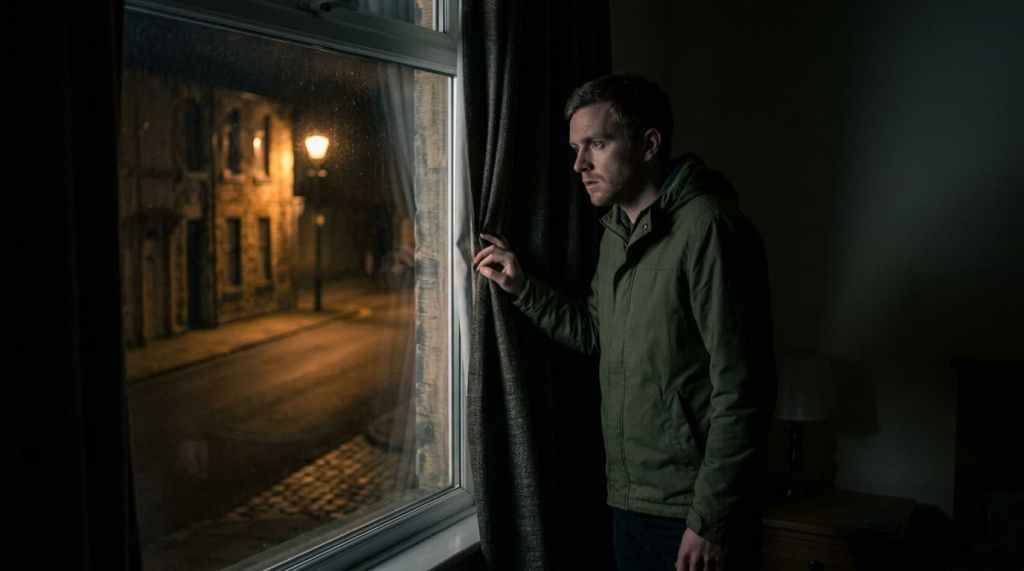
- You’re on edge in situations that look calm to everyone else.
- You startle easily, or can’t relax even when nothing is wrong.
- Some days you feel nothing, as if you’re behind glass.
- A smell, a place or a tone of voice hits you before you know why.
- You can tell the story of what happened without feeling it, or you can’t tell it at all.
- You overreact, then feel ashamed.
- You’re tired of always being the capable one.
- Closeness feels either too much or not enough.
- Your sleep is light, or your mind won’t switch off.
- You’ve never connected what happened then to how you are now.
What trauma is
Trauma isn’t the event. It’s what happens when something is too much, too fast or too alone for you to process, and the mind and body have to cope as best they can.
Two people can live through the same thing and come away differently. That isn’t weakness. It depends on age, on what support was there, and on what came before. A child with no one to turn to is far more likely to be overwhelmed than an adult with someone beside him.
Not every hard experience is trauma, and you don’t need to have been through something extreme to be carrying something. What matters is whether it left a mark that is still shaping how you live.
Kinds of trauma
It tends to fall into a few kinds, and they often overlap:
| Kind | What it looks like |
| Shock | A single overwhelming event: an accident, an assault, a sudden death. |
| Repeated | Living with fear, criticism or unpredictability for months or years, often in childhood. |
| Neglect | What should have happened and didn’t: warmth, attention, being seen. |
| Betrayal | Harm from someone you trusted or depended on. |
| Collective | War, displacement, discrimination or loss that a whole family or community carries. |
Neglect is the one people most often miss, because nothing “happened”. It’s what many men describe in Fathers and family. Collective trauma is part of how identity gets handed down, which Identity looks at.
How the body holds it
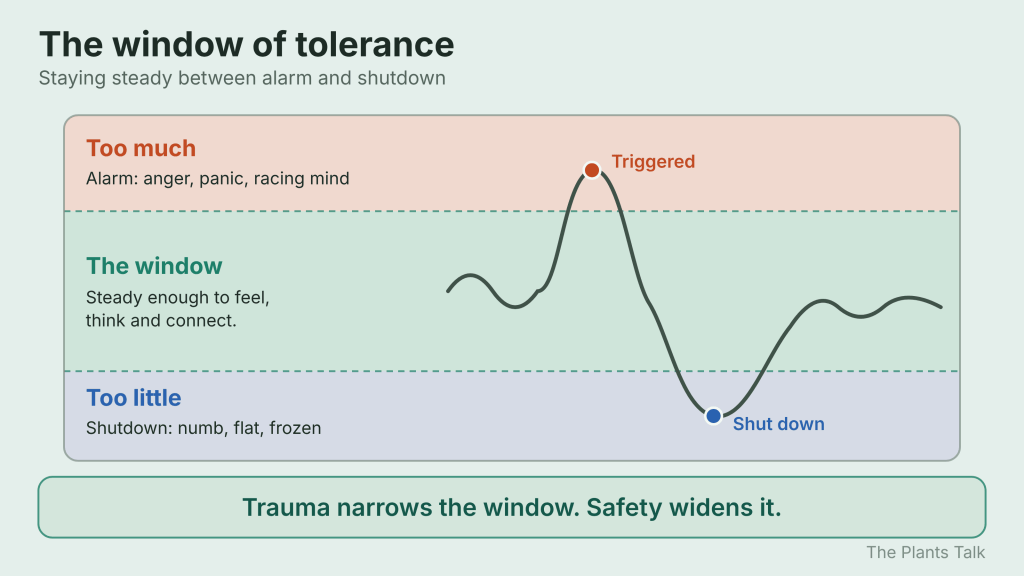
When we sense danger, the body acts before the mind. Heart, breath, muscles and gut all shift to get us through. Normally the alarm rises, we deal with the threat, and it settles. Trauma is what happens when it can’t finish, so the alarm stays on, or the system shuts down to cope.
The psychiatrist Bessel van der Kolk gave his book the title The Body Keeps the Score. I believe he’s right that when something overwhelming can’t be processed, the body carries the effects: in muscle tension, breathing, sleep, startle and how safe a room feels. Emotions and the body looks at this in detail.
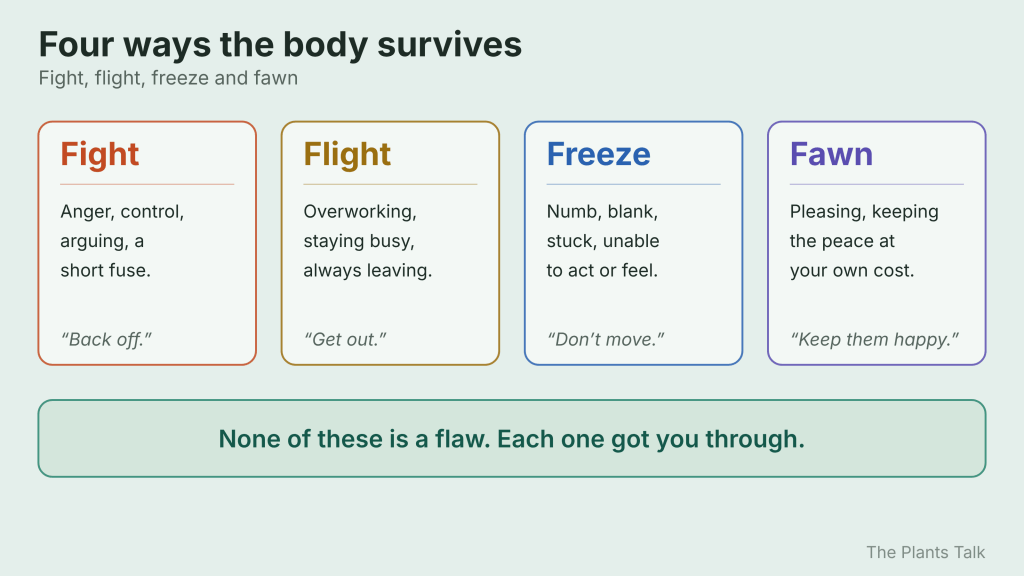
The body has four common ways of surviving a threat:
- Fight. Anger, control, argument, a short fuse.
- Flight. Staying busy, overworking, always leaving, never settling.
- Freeze. Going numb, blank or stuck, unable to act or feel.
- Fawn. Pleasing, appeasing, keeping the peace at your own cost.
Most people use more than one. They aren’t character flaws. They’re what got you through.
If you have physical symptoms that worry you, see a doctor first. This page is about understanding, not diagnosis.
What happens in the brain
The brain has a threat detector that works faster than thought. After trauma it can become oversensitive, reacting to things that merely resemble the danger.
Memory works differently under overwhelm. Instead of being filed as a story with a beginning and an end, a frightening memory can stay as fragments: sensations, images and emotions, without a clear sense of “this was then”. That’s why a smell, a tone of voice or a place can feel as if it’s happening now.
The brain can also change with safety and repetition, which is the hopeful part. Brain looks at how the threat system works, and at how the gut and brain talk to each other.
How it shows up in the mind
- On guard. Scanning rooms, reading moods, always braced.
- Shame. A sense that something is wrong with you, whatever the facts.
- Numbness. Feeling flat, far away, or watching yourself from outside.
- Control. Needing things done a certain way, or needing to be needed.
- Avoidance. Staying away from places, people, topics or feelings.
- A harsh inner voice. Often an old critic that isn’t yours.
- Numbing out. Work, screens, drink, anything that quietens the noise.
These are survival strategies. They made sense once. The cost comes when they keep running long after the danger has gone. The shadow and the unconscious looks at how parts of us get walled off, and Identity looks at the roles we built to cope.
How it connects to everything else
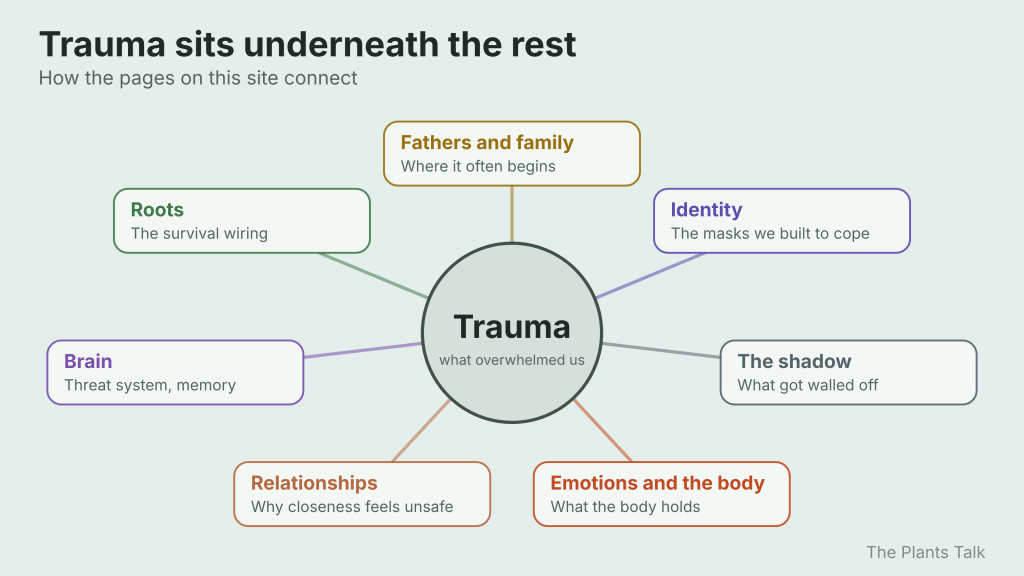
Trauma isn’t a separate topic. It sits underneath most of the others:
- Fathers and family. For many men this is where it starts: the father who was absent, hard or unreachable, and the rules the family ran on. See Fathers and family.
- Identity. The roles and masks we built to stay safe, and the part we left behind. See Identity.
- The shadow and the unconscious. What was too painful to hold gets pushed out of sight and keeps working there. See The shadow and the unconscious.
- Emotions and the body. What the nervous system does with feelings that couldn’t finish. See Emotions and the body.
- Relationships and intimacy. Why closeness can feel unsafe, and why the same patterns keep turning up. See Relationships and intimacy.
- Brain. The threat system, memory, and the nerves that connect gut to brain. See Brain.
- Roots. Why we’re built this way: the survival wiring that trauma switches on. See Roots.
- Plants. The role plant medicines may and may not play, and why safety and support matter. See Plants.
Trauma and relationships
Trauma often does its quietest damage between people. If closeness was once unsafe, it can still feel unsafe, so you pull away, or you grip too tight. You may choose partners who feel strangely familiar, or read a neutral look as a threat. Trust, anger and distance often have an older source. Relationships and intimacy looks at this closely.
Passed down
Families hand on what they haven’t been able to process. I believe it travels mainly through behaviour: the temper, the silence, the rules about feelings, the stories that get told and the ones that don’t. There is also early research on whether severe stress can leave biological marks that pass between generations. It’s interesting, and it isn’t settled.
What is clear is that a father shaped by war, hardship or silence often can’t give what he never had. Fathers and family follows this thread. Communities carry it too, through war, displacement, discrimination or loss, which Identity touches on.
Why it goes unseen
Many men don’t call it trauma. They say “it wasn’t that bad”, “others had it worse”, “I just got on with it”. Being tough was the rule. But how bad it looked from the outside isn’t the measure. What matters is whether you had the support to get through it. If you didn’t, it’s still with you. Playing it down is often a survival strategy in itself.
Moving towards healing
There’s no quick fix and no single route. Many people find these help, roughly in this order:
- Safety first. Healing needs enough stability: a safe place, enough sleep, people who don’t hurt you.
- Go slowly. You don’t need to relive it to heal. Pushing too hard can make things worse.
- Start with the body. Slow breathing, walking, stretching, time outdoors, regular routines. Settle the system before you dig.
- Name it. Put words to what happened and what it did. Naming turns a vague dread into something you can look at.
- Let one person in. Safe connection is one of the most steadying things there is.
- Grieve what was missing. The childhood, the father, the years.
- Tell the story at your own pace. When there’s enough steadiness, writing or saying it aloud can turn fragments into a story with an ending.
- Rebuild trust in small steps. With others, and with yourself.
If it feels overwhelming, don’t do this alone. Talk to a therapist or your doctor, who can point you towards support. If you’re in crisis, use a crisis line (see the note at the foot of the page).
Some questions worth sitting with:
- What did you have to learn, or stop doing, to get through?
- What do you still brace for that is no longer there?
- Who, if anyone, knows the real story?
- What would feel different if you were allowed to put it down?
Common questions
What counts as trauma?
Anything overwhelming that you didn’t have the support to process, from a single event to years of neglect or fear.
Is it trauma if nothing “big” happened?
It can be. Ongoing coldness, criticism or absence can overwhelm a child just as a single event can overwhelm an adult.
Why do I react so strongly to small things?
Often the reaction belongs to something older. The present event just touches it.
Why do I feel numb?
Numbness is a common way of coping when feelings are too much. It protects, but it can also keep good things out.
Why can’t I remember parts of it?
Overwhelm can disrupt how memories are filed. Gaps are common and don’t mean you’re making it up.
Do I have PTSD?
PTSD is a specific diagnosis made by a doctor. Many people carry the effects of trauma without it. If you’re worried about your symptoms, talk to your doctor.
Does time heal it?
Time alone rarely does. What helps is safety, support and being able to process what happened.
Can I heal on my own?
Some people do a lot of it themselves. But connection is central, and if it feels like too much, don’t go it alone.
Is it my fault I still struggle?
No. The way you adapted was clever and necessary. Staying stuck isn’t a character flaw.
Can trauma affect my body?
Stress can show up physically, but physical symptoms have many causes, so see a doctor first.
What’s the difference between trauma and the shadow?
Trauma is about what overwhelmed us. The shadow is about the parts we disowned. They overlap, and each can leave us split off from ourselves. See The shadow and the unconscious.
Can anything good come out of it?
Some people describe a deeper sense of meaning, closeness or strength afterwards. It isn’t guaranteed, and nobody needs to be grateful for what happened.
How long does it take?
There’s no timetable. Progress is usually uneven: forward, back, forward.
Connected to
Fathers and family · Identity · The shadow and the unconscious · Emotions and the body · Relationships and intimacy · Brain · Roots · Plants
Read more
New writing on trauma lands here first. Join the list, or if you’d rather talk, book a free intro call.
If anything here brings up difficult feelings, you don’t have to carry them alone. If you’re in crisis or thinking of harming yourself, please contact your local emergency services or a crisis line. You can find one for your country at findahelpline.com.
