The parts of ourselves we hide, and why they run more of our lives than we think.
What you refuse to look at doesn’t go away. It drives.
Most of what we do each day happens without our deciding it: the tone we take, the people we avoid, the reactions that arrive before the thought does.
Some of that is habit. Some of it is older: parts of ourselves we learned to push out of sight, which carry on working in the dark. This page looks at what the unconscious is, what Carl Jung called the shadow, and how to start meeting it.
Does this sound familiar?
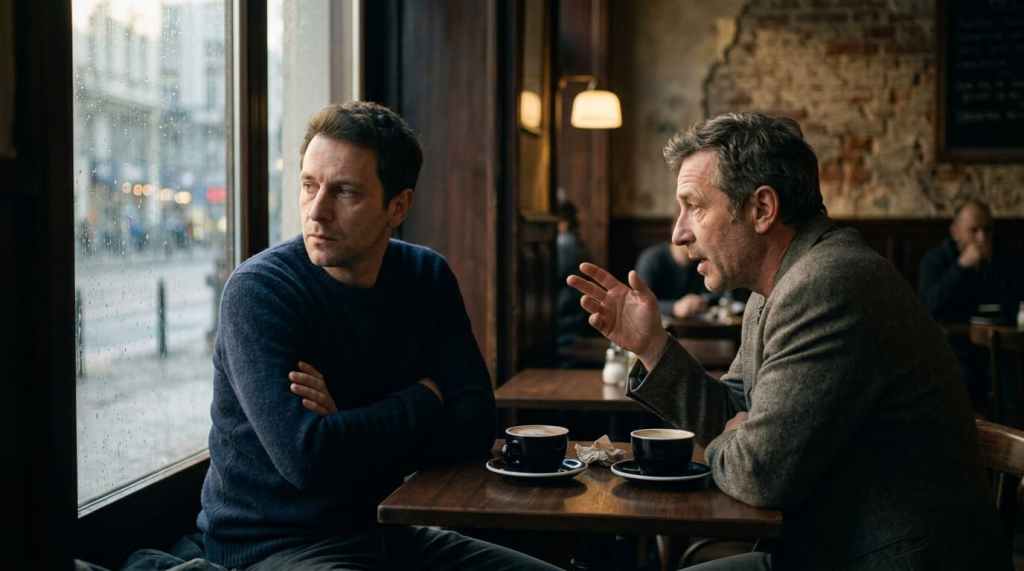
- You react far more strongly to someone than the situation deserves.
- The trait that irritates you most in other people is one you’d never allow in yourself.
- You say “I don’t know why I did that” more often than you’d like.
- You swore you’d never turn into your father, then heard his voice come out of your mouth.
- You have firm rules about who you’d never be, and a few moments that don’t fit them.
- The same pattern turns up in different jobs, partners and friendships.
- Praise makes you uncomfortable, and you can’t quite take a compliment.
- A mood arrives from nowhere and takes the day.
What the unconscious is
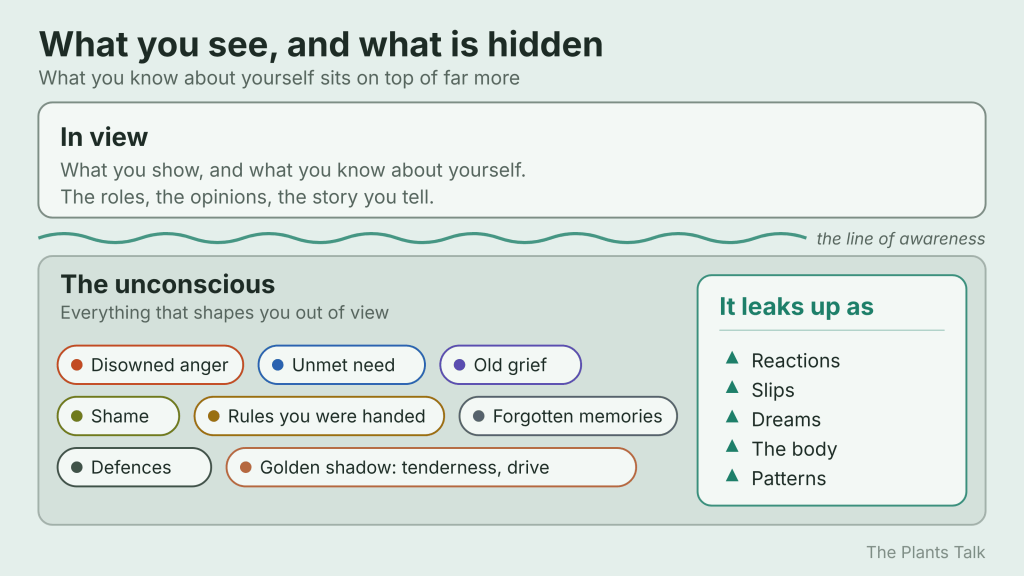
The unconscious is everything that shapes us without being in view: memories we don’t recall, rules we absorbed, feelings we never named. Sigmund Freud described it as where we put what’s too painful to hold. Jung added that it also holds what we haven’t yet become.
Neuroscience agrees with the basic point. Most of what the brain does happens outside awareness, from reading a face to deciding whether a room feels safe. Brain looks at how.
How the unconscious speaks
It rarely announces itself. It shows up in the places we don’t police:
- Slips. The wrong name, or the word that comes out before you meant it.
- Dreams. Freud called them the royal road to the unconscious. Jung saw them as the mind balancing what we leave out by day.
- Humour. The joke that carries a truth you couldn’t say straight.
- The body. A tight chest, a held jaw, a stomach that drops before you know why. See Emotions and the body.
- Patterns. What keeps repeating is often what hasn’t been looked at.
You don’t need to decode any of it. Noticing is enough.
What the shadow is
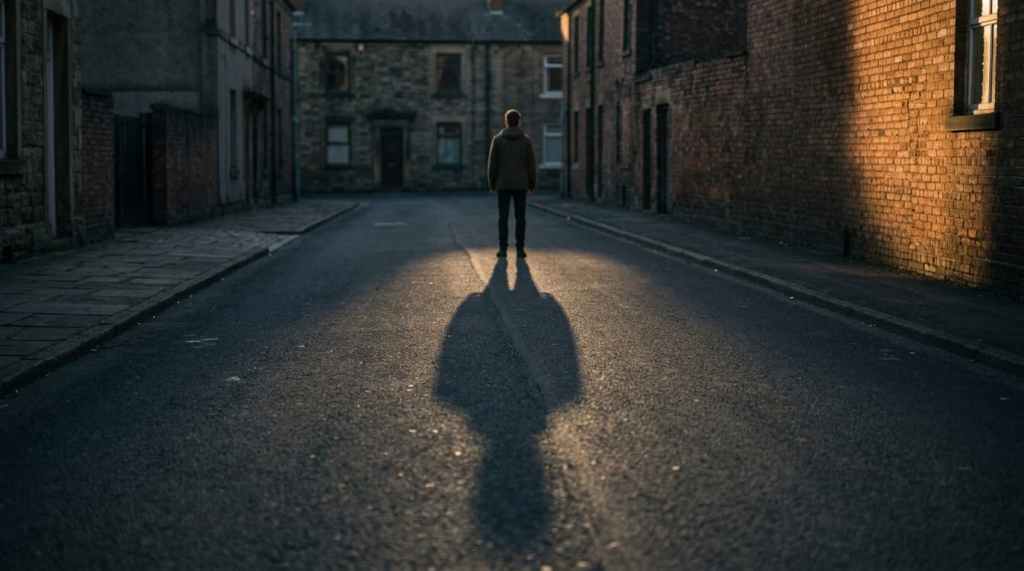
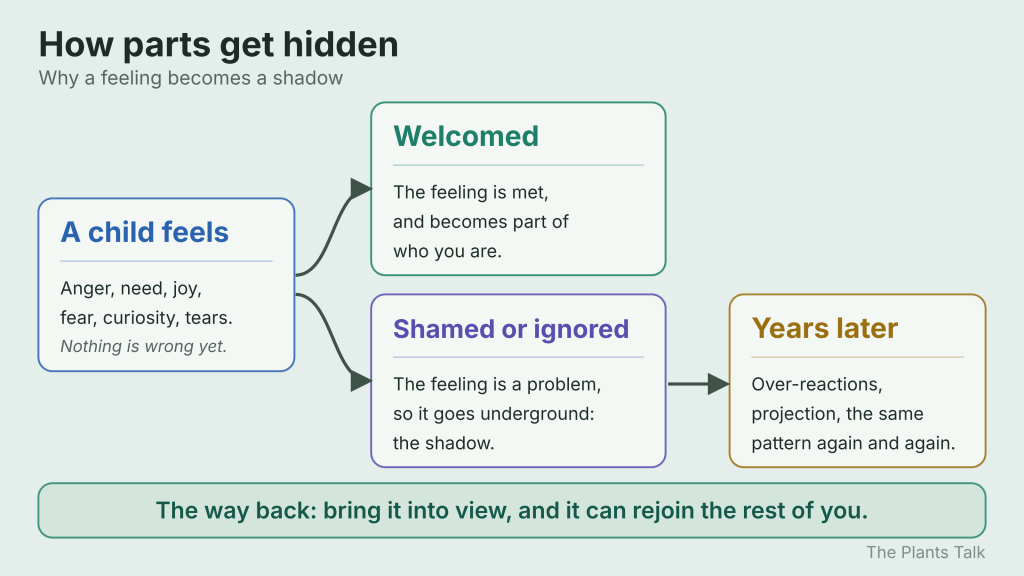
Jung used the word shadow for the parts of ourselves we’ve disowned. Every child learns which parts of them get approval and which don’t. If anger wasn’t welcome, it goes into the shadow. If neediness was shamed, it goes there too. The poet Robert Bly called it the long bag we drag behind us.
The shadow isn’t only dark. Ambition, tenderness, creativity and joy can end up there too if they weren’t safe to show. Jung sometimes called this the golden shadow, and it’s why we can be so struck by qualities in other people that are really our own.
What goes into the shadow depends on what was allowed. Many men were given one acceptable emotion, anger, and had to find somewhere to put the rest: fear, grief, need, tenderness. Those feelings don’t disappear. They wait, and they often return as the anger itself, or as numbness. Emotions and the body looks at what that costs.
This is where Identity and the shadow meet. The part you disowned to fit in doesn’t disappear. It waits.
Why we hide parts of ourselves
For most of human history, being cast out of the group was dangerous. A child who senses that a feeling puts the bond at risk will hide that feeling, without thinking about it. It’s a clever survival move, and it’s how many of the roles in Fathers and family get handed down. Roots looks at where this wiring comes from.
Sometimes the splitting goes further. When something overwhelms a child, the mind can wall it off completely. That is the territory of Trauma.
How the shadow shows up
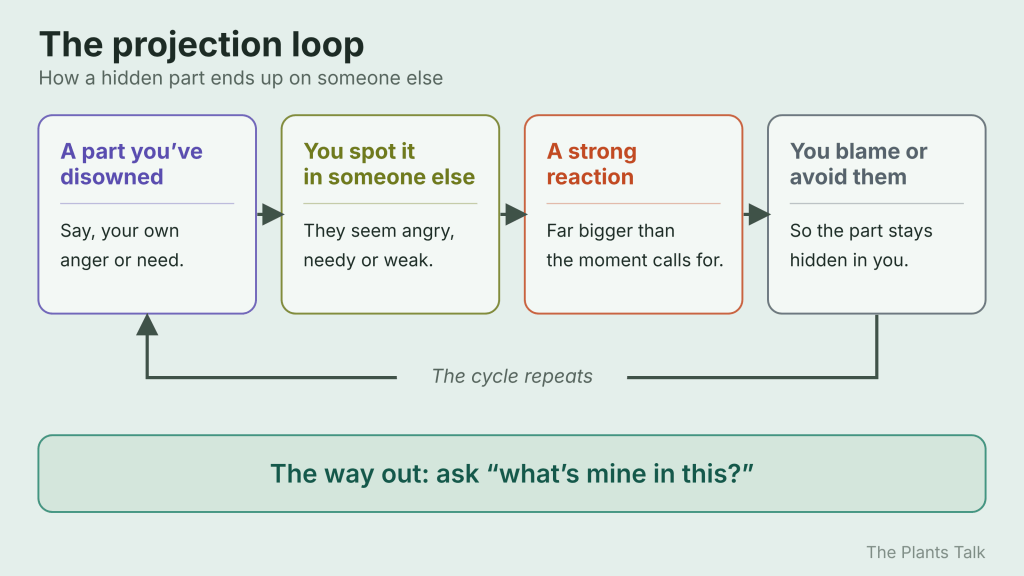
- Projection. You see in others what you can’t see in yourself. The colleague who “always needs to be in charge” may be touching your own buried wish for control.
- Over-reaction. A strong charge that doesn’t fit the moment usually points to something older than the moment.
- Judgement. What we condemn hardest in others is often what we’ve worked hardest to hide in ourselves.
- Repeating patterns. The same relationship, the same argument, the same exit, with different faces.
- In relationships. The partner who “never listens” or “always pulls away” can carry what you can’t own in yourself. Relationships and intimacy looks at this closely.
- Sudden eruptions. Something held down for years comes out sideways: a rage, an affair, a disappearance.
- In the body. A clenched jaw, a held breath, a tightness you can’t explain. See Emotions and the body.
The mind’s defences
Freud and his daughter Anna Freud described how the mind protects us from what feels unbearable. These defences aren’t flaws. They helped. The trouble is when they run the show.
| Defence | What it looks like |
| Denial | “It wasn’t that bad.” |
| Projection | “You’re the angry one.” |
| Displacement | Snapping at the family after a hard day at work. |
| Rationalisation | A tidy reason for a decision made out of fear. |
| Reaction formation | Acting the opposite of what you feel, such as over-politeness covering resentment. |
| Intellectualising | Explaining the feeling instead of feeling it. |
Meeting the shadow
You don’t get rid of the shadow. You get to know it, so it stops running things from behind.
- Notice the charge. When a reaction is bigger than the moment, pause. That’s a doorway.
- Ask what’s yours. What is it about this person that stings? Is any of it familiar?
- List the “I’d never”. Write down what you swore you’d never be. Then look for where it already lives in you.
- Look at who you admire and who you envy. Often it shows what you’ve hidden in yourself.
- Notice what you can’t say. Wants, needs, no. What gets stuck in your throat?
- Give it a safe voice. Write it down, say it aloud, or tell someone you trust. The aim is to hear it, not to act it out.
- Go slowly. Acknowledging a part of you isn’t the same as indulging it. The aim is more choice, not less control.
If what comes up feels overwhelming, slow down and share it with someone you trust.
Where it can go wrong
This work can go wrong in a few ways. It can become an excuse (“that was my shadow, not me”). It can become another mask: the self-aware man performing his own healing. Or it can become a new way to judge other people (“you’re just projecting”). The shadow is yours to own, not to hand out.
What changes when you meet it
Many men find that:
- Reactions get smaller and pass faster.
- There is more choice in the moment.
- The same arguments stop repeating.
- Less effort goes into keeping things down.
- Other people feel less threatening, and less like a mirror.
- Parts they hid, such as tenderness, creativity and drive, become available again.
Some questions worth sitting with:
- What did you learn was unacceptable about you?
- Who in your life gets under your skin, and what do they have in common?
- What would you be allowed to do or feel if nobody was watching?
- What quality do you admire in others that you’ve never claimed?
Common questions
Is the shadow evil?
No. It’s simply what we’ve hidden, and much of it is useful. Anger can be a boundary. Neediness can be a wish for closeness.
Is this the same as the subconscious?
Close enough in everyday use. “Unconscious” is the term psychology prefers.
Is Jung’s shadow proven science?
Jung’s ideas are psychological models, not laboratory findings. I believe they’re useful because they match what many people recognise in themselves, and parts of it, such as automatic processing and defences, have good support.
Why do I get so angry at things that don’t matter?
Often the anger is about something older. The present event just touches it.
Why do I dislike certain people so strongly?
Sometimes they simply behave badly. But a strong, hard-to-explain dislike can mean they’re mirroring something you’ve disowned.
Can I just think my way through it?
Rarely. The unconscious shows itself in feelings, patterns and the body, so noticing works better than analysing.
Does the shadow go away if I face it?
No, and it isn’t meant to. It becomes familiar, and loses its grip.
What’s the difference between the shadow and trauma?
They overlap. The shadow is about parts we disowned. Trauma is about what overwhelmed us. Both can leave us split off from ourselves.
Can the shadow affect my relationships?
Very much so. What we hide in ourselves tends to play out between us and the people closest to us. Relationships and intimacy looks at this.
Is “my shadow made me do it” an excuse?
No. Understanding why you did something explains it. It doesn’t excuse it. Owning your shadow means taking responsibility for it.
How do I tell whether it’s my shadow or their behaviour?
Often it’s both. A useful test is the size of the reaction. If it’s bigger than what happened, it’s worth asking what’s yours.
Is it dangerous to look at the shadow?
Most of the time it’s a relief. Go gently and at your own pace.
Connected to
Identity · Fathers and family · Emotions and the body · Trauma · Relationships and intimacy · Roots
Read more
New writing on the shadow lands here first. Join the list, or if you’d rather talk, book a free intro call.
If anything here brings up difficult feelings, you don’t have to carry them alone. If you’re in crisis or thinking of harming yourself, please contact your local emergency services or a crisis line. You can find one for your country at findahelpline.com.
