Who you are when the roles fall away: the masks we wear, and the person underneath.
Most men can tell you what they do. Far fewer can tell you who they are when they stop.
For many of us, identity was never chosen. It was handed to us, one role at a time, by family, school, work and what got praised. This page looks at where it comes from, what it costs to live behind it, and how to find the person underneath.
Does this sound familiar?
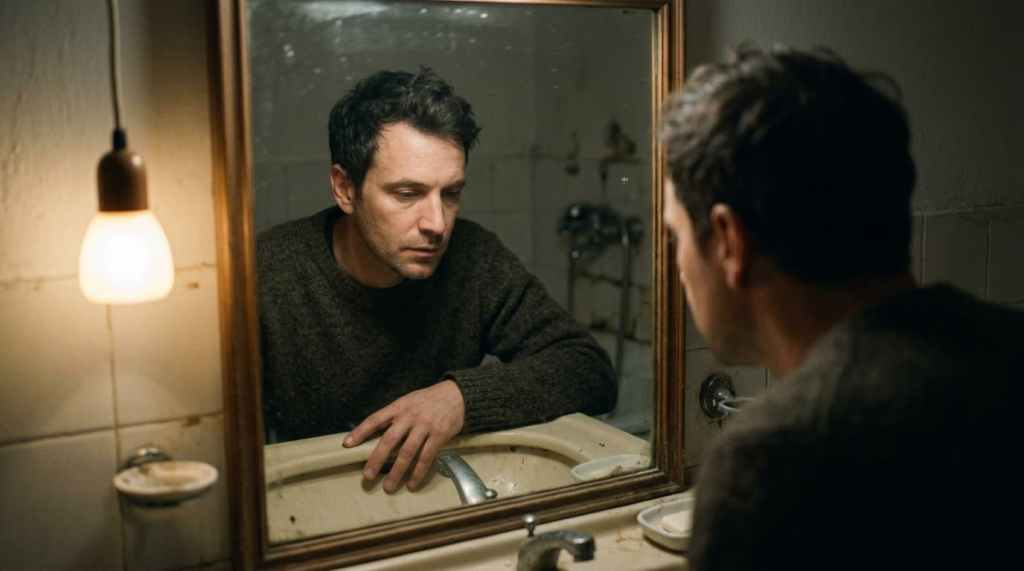
- You feel empty when work is going well.
- You’re a different person depending on who you’re with.
- You feel like an outsider, even among people you know.
- If you stopped being useful, you’re not sure anyone would stay.
- You can’t say what you actually want, only what’s expected.
- A job loss, a breakup or a birthday leaves you wondering who you are.
- You’re always performing, and you’re tired of it.
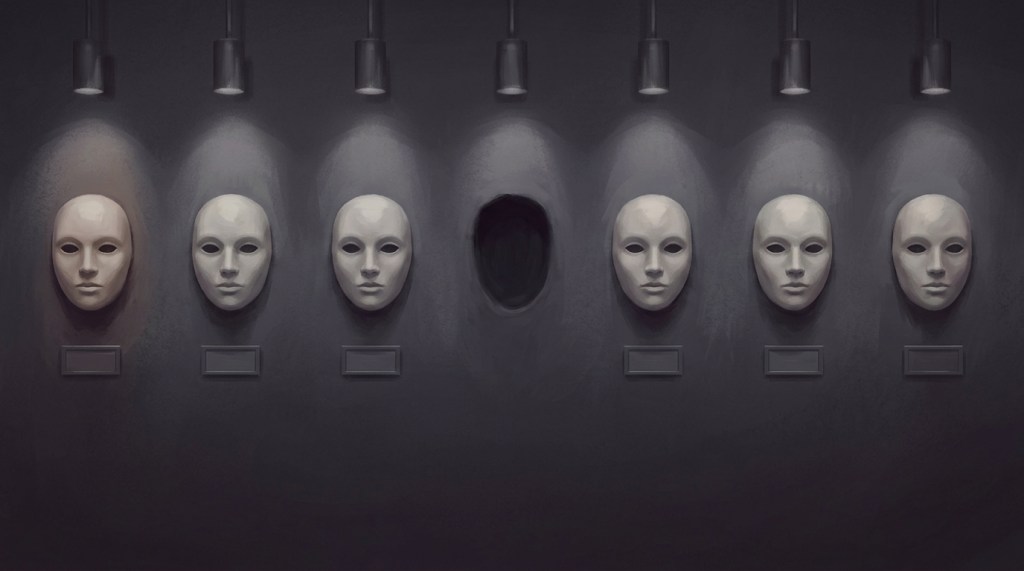
The masks we learn
Most men wear a few, often without noticing:
- The provider. Your worth is what you earn and carry.
- The strong one. Nothing gets to you, and nobody sees if it does.
- The fixer. You solve everyone’s problem except your own.
- The funny one. Humour keeps people at a safe distance.
- The achiever. Stopping feels like falling behind.
- The good guy. You keep everyone happy, and resent it quietly.
None of these is fake. Each one was learned for a reason. The trouble starts when the mask is all there is.
Where identity comes from
A child learns early what earns approval and what doesn’t. If you were praised for what you did, and rarely for who you were, you learn that you’re valued for being useful. If feelings weren’t welcome, you learn to hide them. Many of these lessons began in Fathers and family: the roles a family hands to its sons, and the things it never said.
Underneath all of it is an older drive: the need to belong. We follow that thread in Roots.
Who you are: the individual and the group
Different societies answer “who am I?” in different ways.
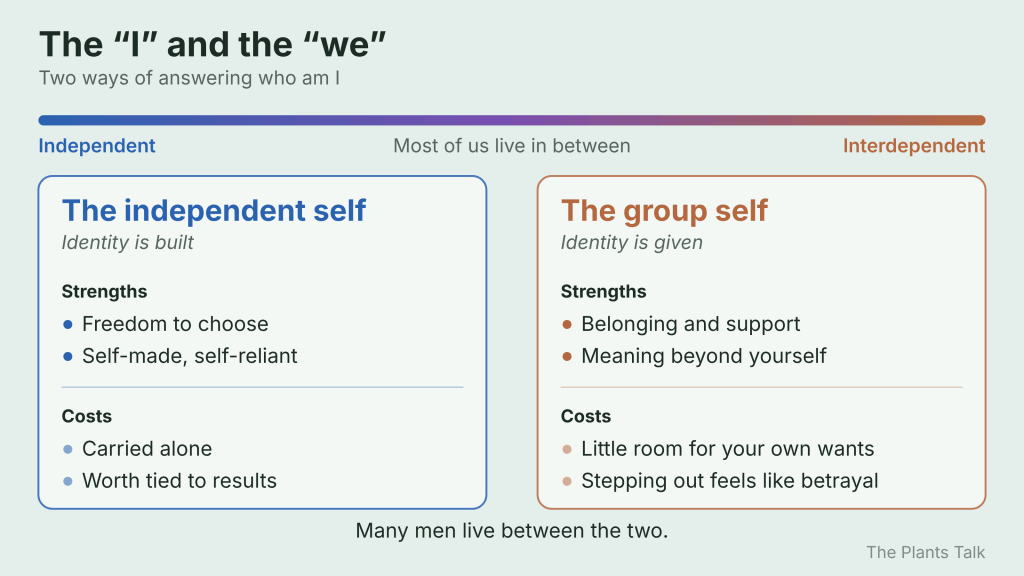
In more individualist cultures, which include much of the West, identity is something you build: your achievements, your choices, your independence. The risk is that if you’re only what you’ve achieved, you’re only as secure as your last result, and you carry it alone.
In more collectivist cultures, identity sits in the group: your family, your community, your duty and your place within them. The strength is belonging. The cost can be that your own wants, feelings and choices have little room, and stepping outside the role feels like betraying people you love.
Neither is the better one. Every society has both, and most of us carry a mix. Many men live between the two, such as the son of a family that expects duty, raised in a place that expects independence. You can feel too much like a role to the people at home and too little like yourself anywhere.
Which story did you inherit about who a man is supposed to be? Whose did you pick up along the way? And where do they pull against each other?
When you’re “not one of us”
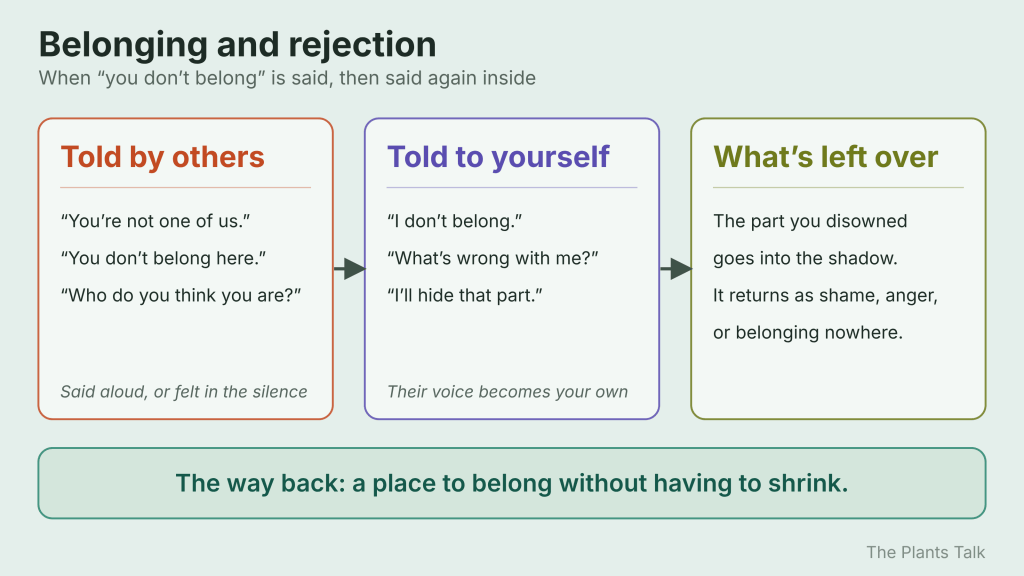
Identity isn’t only something we hold. It’s also something others grant or withhold. “You’re not one of us.” “You don’t belong here.” “Who do you think you are?” These can come from a family, a community, a workplace, a culture, or a group of friends. They can be said out loud, or just felt in the silence.
For most of human history, being cast out of the group was a danger to survival. That wiring is still there, and it’s why exclusion can register in the body as a threat: a drop in the stomach (the gut has its own network of nerves, which we look at in the gut and the enteric nervous system, heat in the face, a sinking sense of shame. It hurts far more than it “should”, and the words can stay with a man for decades. Roots looks at where this comes from.
There’s a second side, which is rejecting yourself. Many men learn to disown a part of who they are: where they come from, how they speak, the family they grew up in, a father they swore never to be like, or a background they learned to feel ashamed of. You may change your accent, your name, your friends, your story. It can look like freedom, and sometimes it is. But the part you disown doesn’t go away. It sits in the shadow, and often resurfaces as shame, anger or a sense of not belonging anywhere.
The two tend to arrive together. The group says you’re not one of us, and then you say it to yourself. Over time you can find you don’t fully belong to the old group, or the new one, or even to yourself.
Some questions worth sitting with:
- Where have you been told you don’t belong, and by whom?
- What part of yourself did you learn to hide, change or reject to fit in?
- Whose approval are you still trying to earn?
- What would it mean to belong somewhere without having to shrink?
What psychology adds
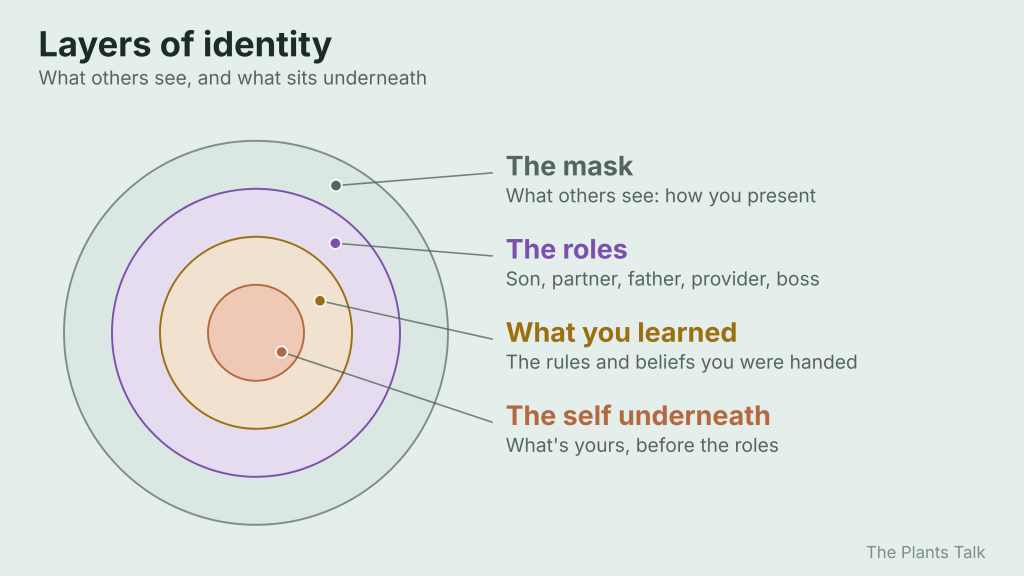
Two ideas help here. Carl Jung called the face we show the world the persona, a mask that makes life in company possible. Donald Winnicott described a false self: a self built to meet other people’s needs, which protects the real one but can end up replacing it.
The point isn’t to throw the mask away. It’s to know it’s a mask.
How it lives in the body
Performing takes energy. Many men notice a held breath, a fixed expression, tight shoulders, a voice that drops or hardens in certain company. Keeping watch on how others see you keeps the body’s alarm quietly switched on, which is part of why it’s tiring. Brain looks at how the nervous system does this.
Notice the opposite too: who are you with when your shoulders drop and your breath deepens? That’s often where the real self is.
If you have physical symptoms that worry you, see a doctor first. This page is about understanding, not diagnosis.
When the roles break

Identity tends to surface when a role is lost or finished:
- losing a job or a business
- a divorce or the end of a relationship
- becoming a father
- a success that doesn’t feel like it should
- a parent’s death
- a milestone birthday
These moments feel like crisis, but they’re often the first honest look at what was underneath.
How it shows up in adult life
- At work: over-identifying with the role, or fear of being found out.
- In relationships: becoming whoever the other person needs, then feeling lost in it.
- In friendships: being known for the role, not the person.
- Belonging: being with people but never feeling fully part of it, or being the one who changed and left others behind.
- Between cultures: feeling like a different person at home and outside it.
- With yourself: a harsh inner voice that measures you against a standard you didn’t choose.
Coming back to yourself
- Notice the mask moments. When do you change your voice, your posture, your opinions?
- Ask whose voice it is. Is the rule yours, or one you were handed?
- Separate who you are from what you do. Try finishing “I am…” without a job, a role or a relationship.
- Notice what you do when nobody’s watching. That’s often closer to you.
- Let one person see the real you. One honest conversation does more than any amount of thinking.
- Make small honest choices. Say what you actually want, in something small.
Common questions
Is the mask fake?
No. It was learned to cope, and often helped. It becomes a problem when there’s nothing else.
Why do I feel empty when things are going well?
Often because success was built on a role, not on knowing who you are. The achievement arrives, and the person it was for isn’t quite there.
Why do I change depending on who I’m with?
Adapting is normal. It becomes a problem when you lose track of what’s yours in the process.
Why does being excluded hurt so much?
Because belonging once meant survival. The body can treat exclusion as a threat, not just as an insult.
Is it wrong to leave the identity I was given?
No. Growing beyond the role you inherited is part of becoming yourself. The aim isn’t to reject where you came from, but to stop being defined only by it.
Is it wrong to put family before myself?
No. Duty and belonging are real strengths. The question is whether there’s also room for you.
What if my culture and I want different things?
That tension is common, especially in families that have moved between cultures. It’s usually a sign of two loyalties, not a flaw in either.
What if I was rejected by my own family or community?
It’s one of the deepest wounds, because it comes from the people you most needed. It makes sense that it hurts. Many men carry it silently, and it’s worth naming.
What is an identity crisis?
It’s a period when the roles and beliefs you relied on stop working, and you have to ask who you are without them. It’s uncomfortable, and it’s also often a turning point.
How do I find out who I am?
Rarely by thinking harder. Notice what you value, what drains you, what you do unobserved, and how your body feels around different people.
Connected to
Fathers and family · Emotions and the body · The shadow and the unconscious · Trauma · Roots
Read more
New writing on identity lands here first. Join the list, or if you’d rather talk, book a free intro call.
If anything here brings up difficult feelings, you don’t have to carry them alone. If you’re in crisis or thinking of harming yourself, please contact your local emergency services or a crisis line. You can find one for your country at findahelpline.com.
