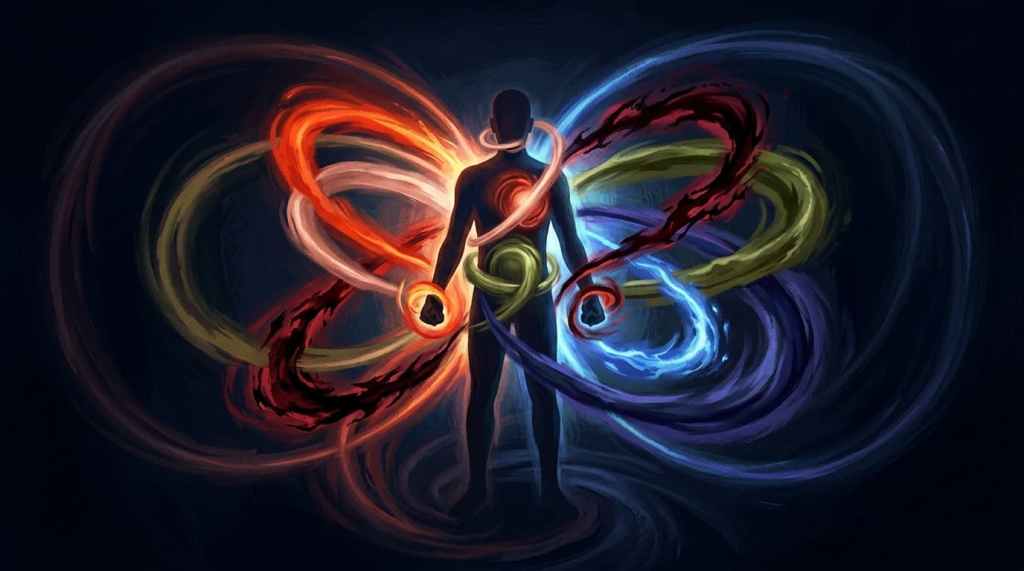
Every emotion carries a charge. When it can’t move, it gets stuck, and the body holds it.
An emotion that never gets to finish doesn’t disappear. It waits in the body.
The word emotion comes from the Latin for “to move out”. An emotion is meant to rise, be felt, and pass through. Many of us learned to stop it halfway. This page looks at what that costs, in the body, the nervous system and the mind, and how the pieces connect.
Does this sound familiar?
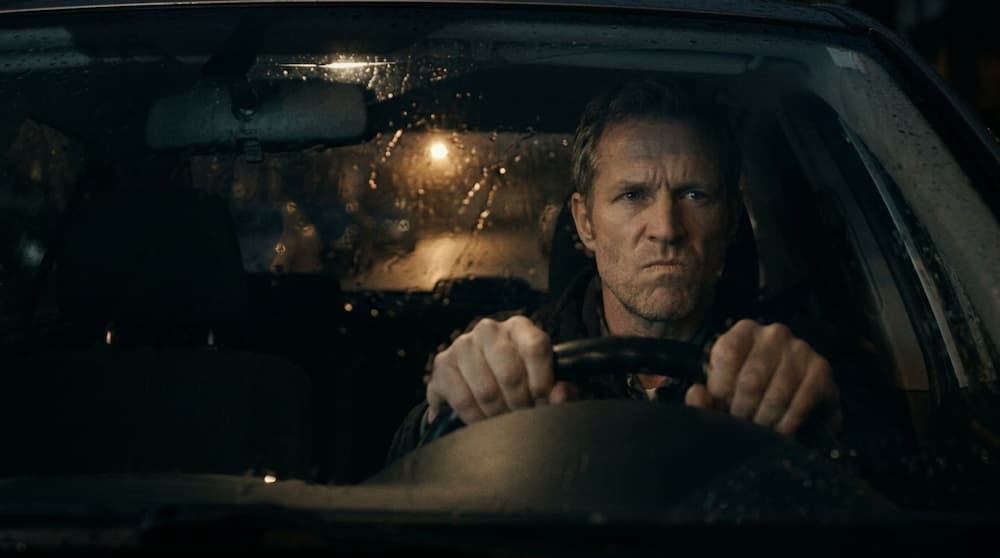
- You’re tense for no reason: jaw tight, shoulders up, stomach in a knot.
- You go from fine to furious in seconds.
- Someone asks what you feel and you don’t know.
- You’re always on edge, or always flat. There’s no in between.
- You can talk about what happened without feeling anything at all.
- You feel worn out by something you can’t name.
- You’ve “dealt with it”, but your body hasn’t got the message.
Emotions as energy
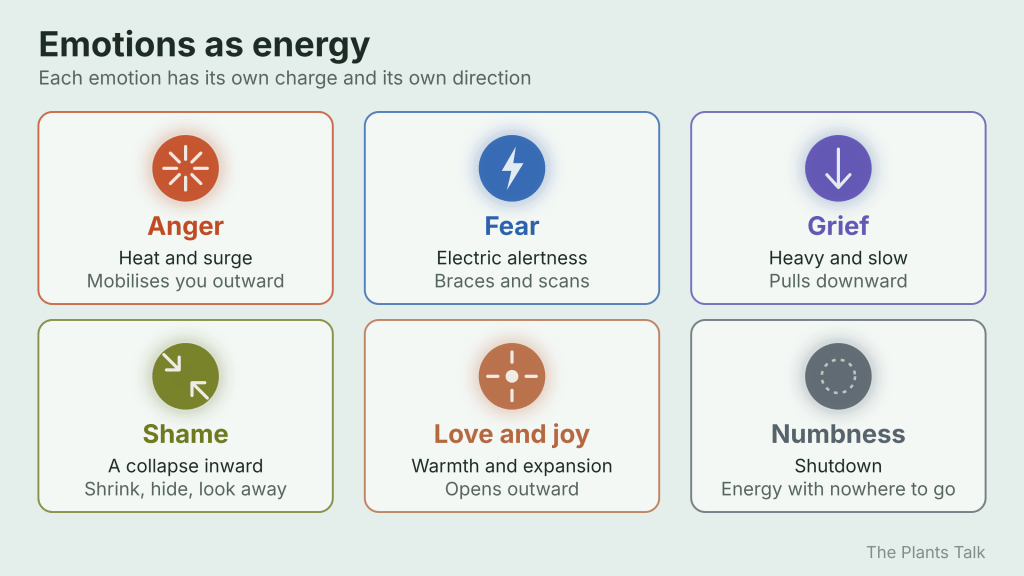
Each emotion has its own feel, a different kind of energy moving through you:
- Anger: heat and surge. It mobilises you to act, push or protect.
- Fear: a sharp, electric alertness. The body braces and scans.
- Grief: heavy and slow, pulling downward. It asks for time.
- Shame: a collapse inward. You shrink, hide, look away.
- Love and joy: expansion and warmth, an opening outward.
- Numbness: shutdown. The energy is still there, but there’s nowhere for it to go.
None of these is wrong. Trouble starts when one of them gets stuck, and you live in it instead of passing through it.
Anger, fear and the urge to shut down belong to the body’s survival responses: fight, flight, freeze or fawn. Underneath each one is an older programming, shaped by conditioning and by survival wiring we inherited long before we had words. We follow that thread in Roots.
Anger is often cover for something softer: hurt, shame or fear. And shame is different from guilt. Guilt says I did something bad. Shame says I am bad, and it’s the one that makes us hide.
How emotions work through the body
Every emotion is also a physical event. Your nervous system reads what’s happening, inside you and around you, and prepares the body to respond. Brain looks at this in depth. Here’s the short version:
- Alarm (the accelerator). Heart rate rises, breathing quickens, muscles tense, digestion slows. This is fight or flight, and it’s where anger and fear live.
- Safety (the brake). Heart rate slows, breathing deepens, muscles soften, digestion resumes. This is rest, connection and ease.
- Shutdown. When a threat feels overwhelming or inescapable, the system can freeze or collapse: numbness, heaviness, flatness.
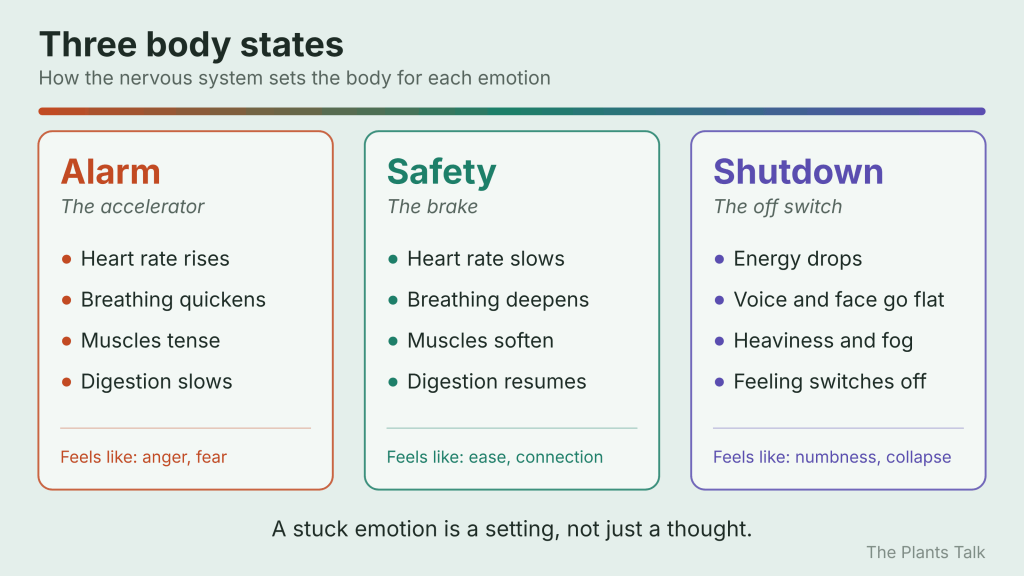
A body that has spent years on the accelerator, or stuck on the brake, feels normal to the person living in it. A stuck emotion isn’t only a thought. It’s a setting.
The signals run both ways. The brain tells the body what to feel, but the body is constantly sending signals up to the brain about the heart, breath, gut and muscle tension. That’s a big part of how we know what we feel at all. The gut has its own dense network of nerves, which we look at in the gut and the enteric nervous system.
Many men notice all this as a clenched jaw, a tight chest, a knot in the stomach, locked shoulders, shallow breathing, a racing heart, or a heavy flatness. These are physical responses, not just sensations, and learning to read them is often the first honest answer to “what am I feeling, and why?”
If you have physical symptoms that worry you, see a doctor first. This page is about understanding, not diagnosis.
Thought, feeling, body, behaviour: one loop
A thought brings a feeling. The feeling changes the body. The body changes what we do. What we do feeds the next thought.
He’s ignoring me → anger and hurt → jaw tight, heart up, breath short → you snap, or go silent → which seems to prove the thought was right.
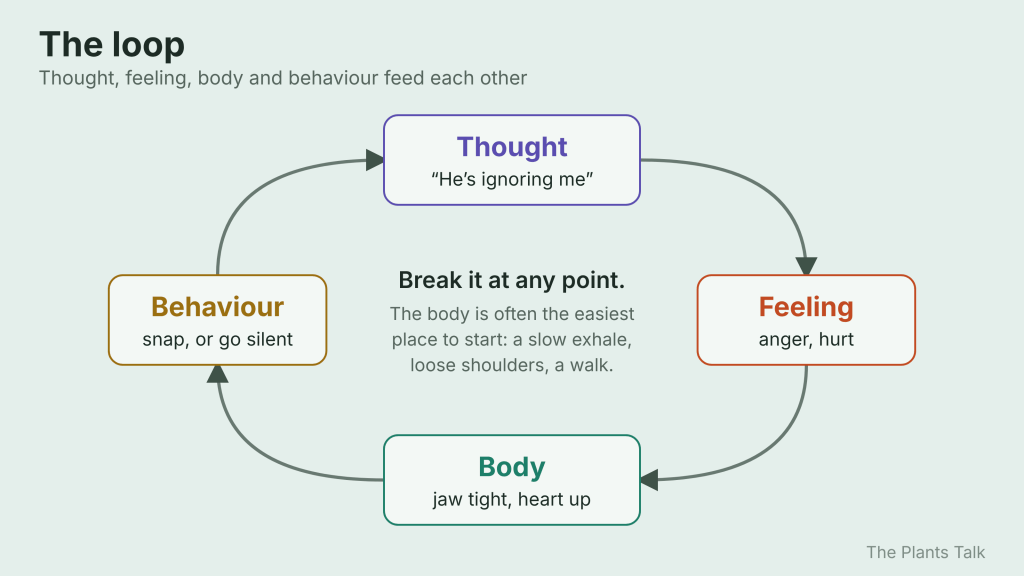
The loop can be broken at any point, and the body is often the easiest place to start. A slow exhale, loosening the shoulders, a walk. Breathing slowly tends to calm the system, and a clenched body tends to feed the alarm.
What the body shows
The body often shows what we’re feeling before we’ve said a word.
| Emotion | What the body does | What it can look like |
| Anger | Heart rate and tension rise, heat, clenched muscles | Tight jaw, clenched hands, forward lean, clipped voice |
| Fear | Alertness, shallow breath, gut tightens | Stillness or restlessness, held breath, wide eyes, rigid posture |
| Shame | Heat in the face, sinking feeling | Head drops, shoulders collapse, gaze turns away |
| Grief | Heaviness, throat tightness, slowed movement | Slumped posture, sighing, tears, withdrawn |
| Joy and ease | Relaxed muscles, deeper breath | Open posture, soft shoulders, a face that moves |
| Shutdown | Low energy, flat tone | Blank expression, slow, distant |
A word of caution. One gesture means little. What matters is the pattern and baseline physiology, how it changes, and what’s normal for that person. The best place to start is yourself: what does your body do when you’re stressed, or ashamed, or pretending to be fine?
When an emotion gets stuck
Boys are taught which feelings are allowed. Anger and toughness are fine. Fear, grief and need are not. So we lose the words for what we feel (researchers call this alexithymia), but the feeling doesn’t go away. It gets held: in the muscles, the breath, the gut, the way you carry yourself. Grief with no room goes somewhere else.
A man can stay in the anger of a childhood long after the childhood has gone. He can stay braced for a threat that ended years ago, or never happened at all, or go flat because feeling was never safe. The situation changes, but the body keeps the state.
I believe the body keeps the score. What we couldn’t feel at the time is still held, in the body as well as the memory, and it shapes how we react, rest and relate years later. This idea has been explored in depth by researchers and clinicians like Bessel van der Kolk, and it matches what many people notice in themselves. How this connects to Trauma is on its own page.
What psychology and psychoanalysis add
Psychoanalysis has long said that feelings pushed out of awareness don’t vanish. They’re repressed (pushed down without realising), or suppressed on purpose because dealing with them takes more effort and energy. Either way they leak out sideways.
Three patterns follow:
- Defences. Humour, busyness, irritability and “I’m fine” protect us from feelings we can’t bear.
- Acting out. What can’t be felt gets done: the explosion, the drink, the withdrawal.
- Repetition. An unfelt emotion tends to recreate the situation that produced it.
Naming the pattern is not the same as feeling it, but it’s where the change begins. More on this in The shadow and the unconscious.
Putting it together
Seen on its own, each piece looks like a separate problem: the temper, the tension, the numbness, the habit. Together they make one system:
- Roots explain why: the survival wiring and early conditioning that set the pattern.
- Brain explains how: the nervous system that turns a threat into a feeling and a feeling into a body state.
- Mind explains what it means: the thoughts, defences and stories that grow around it.
- Body is where it shows: the posture, breath and tension that everyone else, and you, can read.
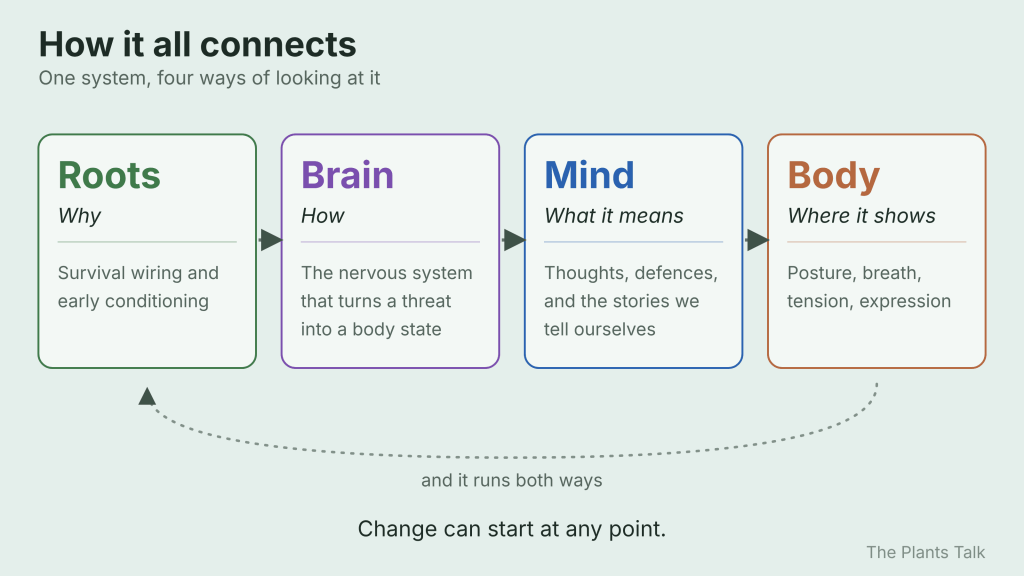
That’s why it helps to see the whole picture first.
How it shows up in adult life
- At work: irritability under pressure, or running on empty without admitting it.
- With anger: reacting first and regretting it later, or swallowing it until it blows.
- In relationships: going quiet when it matters, or being flooded by feelings you can’t explain.
- In how you switch off: the drink, the screen, the gym doing a job that talking never got to do.
Letting it move

- Notice where it lives. Find it in the body. Is it a tight chest, a hot face, a hollow gut?
- Name it. Go beyond “fine”, “angry” and “tired”. Is it fear, hurt, shame, grief?
- Give it somewhere to go. Walking, lifting, swimming, a long exhale. Feelings need movement, not just thought.
- Ask what it’s protecting. Anger often guards something softer.
- Say it to someone. One person, out loud, can change how a feeling sits.
Common questions
What does “the body keeps the score” mean?
It’s the idea that experiences we couldn’t process leave their mark in the body and nervous system, and shape how we feel and react later. It’s the title of Bessel van der Kolk’s book.
Can an emotion really get stuck?
In experience, yes. Many people find themselves in the same state, anger, anxiety or flatness, long after the cause has gone.
What does the nervous system have to do with emotions?
It’s what turns a thought or a threat into a physical response, from heart rate and breath to muscle tension and gut. Emotions are partly physical events.
Can changing my breathing change how I feel?
Often, yes. Slow breathing, with a longer exhale, tends to settle the body’s alarm response. It’s not a cure, but it’s a practical starting point.
Can you read emotions from body language?
Often you can pick up on them, especially in clusters of signs and in changes from someone’s normal. It’s less reliable as mind-reading and more useful as a way of noticing yourself and others.
Why do I feel nothing?
Numbness is common in men who spent years switching feelings off to cope. It’s usually overload, not emptiness.
Is anger always a bad thing?
No. Anger can mark a line or signal something’s wrong. It becomes a problem when it’s the only feeling you have.
Do I have to relive the past to release it?
Not necessarily. Many people start by simply noticing what’s happening in the body now, with care, and building from there.
Connected to
Trauma · The shadow and the unconscious · Brain · Roots
Read more
-
Emotions and the body
New writing on emotions and the body lands here first. Join the list, or if you’d rather talk, book a free intro call.
If anything here brings up difficult feelings, you don’t have to carry them alone. If you’re in crisis or thinking of harming yourself, please contact your local emergency services or a crisis line. You can find one for your country at findahelpline.com.
