
Why relationships can feel so hard, and what to do about it
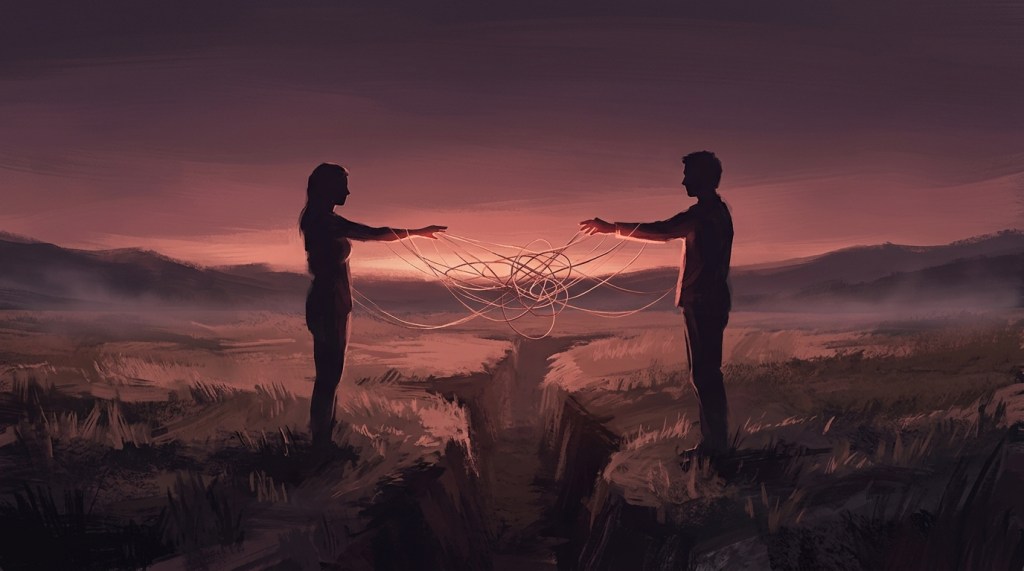
You want closeness, and then you pull away. Or you reach for them and they push you away. Pull and push, again and again.
Most of how we love isn’t chosen. The tone we take when we’re hurt, the way we go quiet or cling, the people we’re drawn to: much of it was set long before we met anyone.
Some of that is habit. Some of it is older, learned from the people who raised us and how available they were. This page looks at why relationships can feel so hard, the patterns that keep repeating, what happens when one person gives to be kept and the other struggles to give back, and how to start changing it.
Does this sound familiar?
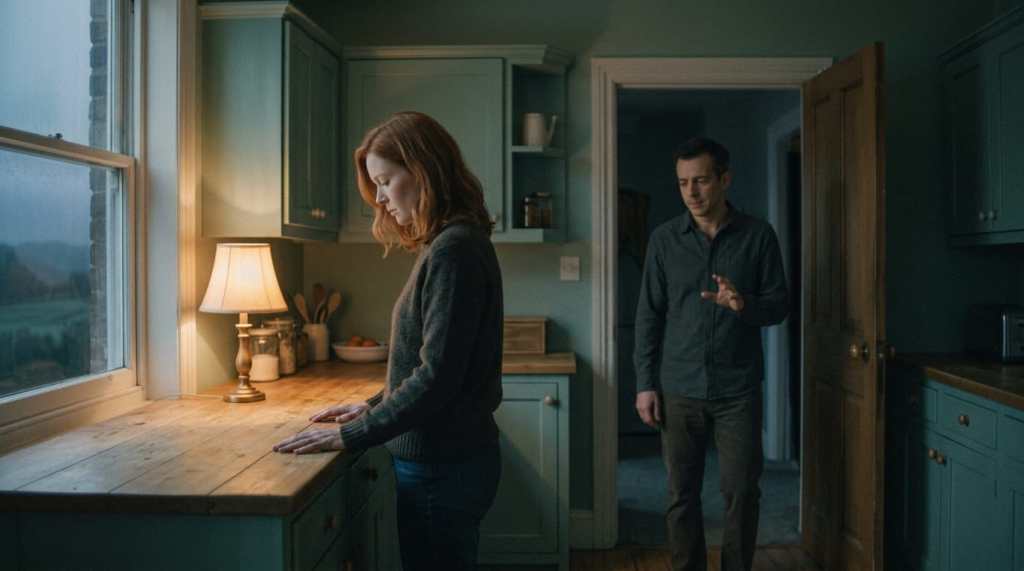
You love your partner, but when they want to talk about feelings, you go quiet or leave the room. Or it’s the other way round, and you’re the one chasing, needing reassurance and fearing being left. You give and give, and it never feels like enough. The early weeks felt like a dream, then something changed and you can’t say when. Arguments and breakups follow the same script every time.
None of this means something is wrong with you. Closeness is a skill, and most of us learned it, or didn’t, long before we chose any relationship.
Where it starts: the parent who wasn’t there
The psychiatrist John Bowlby proposed that the bonds we form as children shape how we connect for life. A child needs a parent who is emotionally available: someone who notices, soothes and stays. Many of us didn’t have that. Our parents may have been present in the room but absent in every other way. They may have been anxious, busy, critical, unpredictable, or unable to cope with feelings, theirs or ours.
The paediatrician and psychoanalyst Donald Winnicott spoke of the “good enough” parent: not perfect, but attuned enough, and able to repair. When that wasn’t there, a child adapts. Some learn to cling. Some learn to need nothing. Some learn to keep the peace. These adaptations feel like personality, but they started as survival. We then repeat them, because they’re the only way of loving we know. For more on how this passes down, see Fathers and family.
Why closeness can feel unsafe
As children, we work out what happens when we reach for someone. If comfort came, closeness feels safe. If we were ignored, criticised or shamed, the lesson is different: needing people is risky. That lesson sits beneath adult life and can switch on without our noticing. This is often how Trauma shows up in relationships: not as a memory, but as a reflex to pull back, cling on or shut down just when someone gets near.
A partner doesn’t have to do anything wrong to set it off. Warmth itself can feel like a threat if warmth once came with conditions, with strings attached, with worth that had to be earned.
The attachment patterns
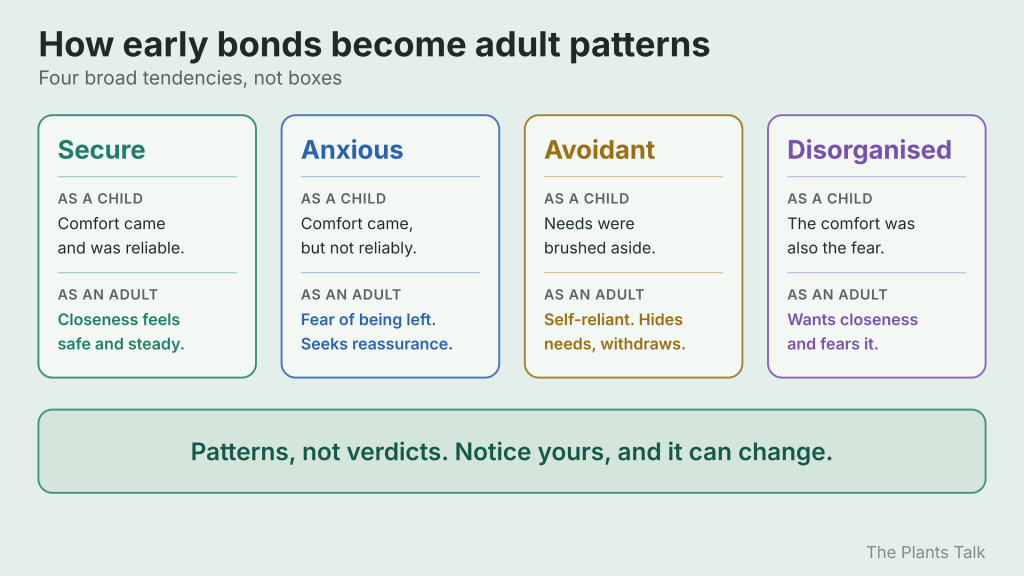
Researchers since Bowlby have described broad patterns. They’re tendencies, not boxes, and most of us move between them depending on who we’re with and how stressed we are.
- Secure. Comfortable with closeness and with independence. Can ask for what you need and hear a “no” without panic.
- Anxious. Closeness is the goal, and distance feels dangerous. You may seek reassurance, read rejection into small things and struggle to settle.
- Avoidant. Independence is the goal, and closeness feels like a loss of control. You may value self-reliance, hide needs and withdraw when someone gets too near.
- Disorganised. You want closeness and fear it at the same time, often because the person you turned to was also the source of fear. Relationships can feel confusing and intense.
I believe these patterns are best used as a mirror, not a verdict. Spotting yours is the start of changing it.
The pull and the push
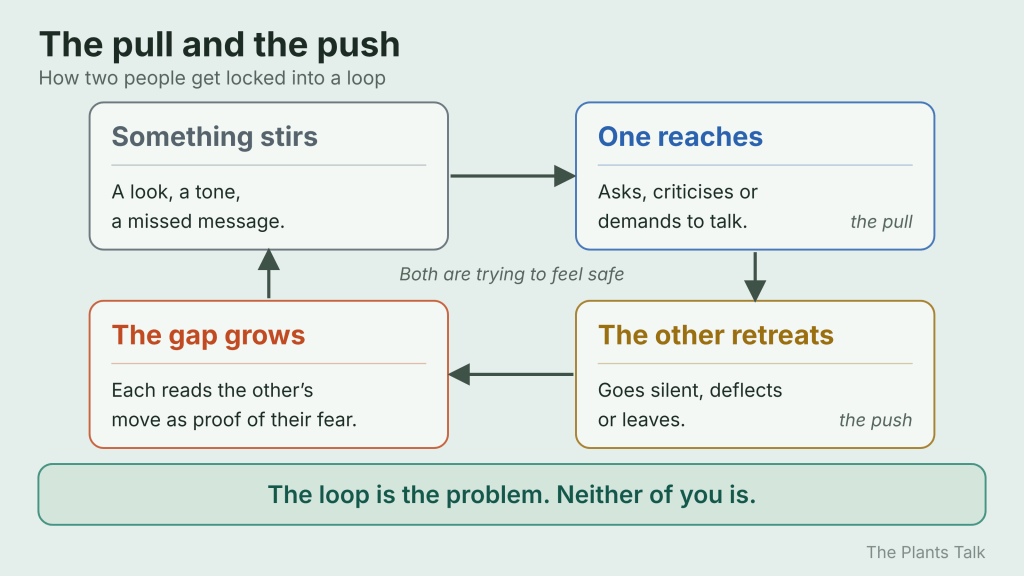
Two different patterns in one relationship can lock into a loop. One partner moves towards closeness and the other moves away. The more one pushes, the more the other withdraws, and the more the other withdraws, the harder the first pushes. Both are trying to feel safe. Neither is the villain.
- Something stirs. A look, a tone, a missed message.
- One reaches. They ask, criticise, or demand to talk.
- The other retreats. They go silent, deflect, or leave.
- The gap grows. Each reads the other’s move as proof of their fear.
The researcher John Gottman called the withdrawing side “stonewalling”, and found it to be one of the more damaging patterns in couples who struggle. Seeing the loop as the problem, rather than each other, is often the first real shift.
Why we choose who we choose
Freud noticed that we tend to repeat what we haven’t understood, which he called the repetition compulsion. In love, it often means we are drawn to what feels familiar, not what is good for us. A partner who is emotionally distant can feel strangely like home if a parent was. Calm and kindness can feel boring, or even suspicious, because they don’t set off the old feeling of striving.
We also tend to pick partners who fit our pattern. Someone who learned to give to earn love often finds someone who is comfortable receiving. That doesn’t make either of them a bad person. It makes a lock and a key.
The giver: when love has to be earned
Some people grew up learning to read the room. They noticed a parent’s mood before their own, soothed it, and made themselves useful. The psychoanalyst Alice Miller described this in The Drama of the Gifted Child: the sensitive child who becomes attuned to a parent’s needs and loses touch with their own. Winnicott called the result a “false self”, the part that performs and pleases. See Identity.
In adult relationships, this person gives to earn validation. They are generous, attentive and agreeable, and often the one who buys the gifts, plans the holidays and says yes. Underneath is a belief: I am only worth keeping if I give. Giving becomes a way of buying safety, and it can never quite fill the gap, because the need is for acceptance, not for another gift.
- You can’t say no. A “no” feels like risking the relationship.
- You over-give. Time, money and energy, beyond what is fair.
- You don’t know what you want. You have been shaping yourself to fit someone else for so long.
- You swallow your anger. It goes underground and leaks out as resentment, exhaustion or the body. See The shadow and the unconscious.
- You feel invisible. You give and give and still feel unseen.
Being kind isn’t the problem. Giving from freedom is a gift, and giving from fear is a payment. The question to ask yourself is: If I stopped giving, would I still feel I deserve to be here?
When a partner’s pattern is hard to live with
Some relationship difficulties go deeper than a mismatched attachment style. Psychiatry describes a group of long-standing personality patterns, set out in manuals such as the DSM-5 and ICD-11, where people struggle with empathy, stability or trust in ways that affect those close to them. Only a qualified clinician can diagnose a personality disorder, after assessing the person themselves. Most of us show some of these traits some of the time. But knowing what the patterns look like can help you make sense of an experience that otherwise feels confusing.
It’s also worth knowing where these patterns come from. Psychoanalysts such as Freud, Kohut, Kernberg and Winnicott all pointed, in different ways, to early experience: conditional love, neglect, shaming or unsafe attachment. Many people with these patterns are in real pain, and the pain often drives the behaviour. That is an explanation, not an excuse for being treated badly.
| Pattern | What it can look like | What may be underneath |
| Narcissistic | Needs admiration, expects special treatment, struggles to see your point of view, turns criticism into an attack. A quieter form can look sensitive, withdrawn and easily wounded. | Fragile self-worth, protected by a grand or defended image. Shame is never far away. |
| Borderline | Intense, fast closeness and a terror of being left. Swings between idealising and devaluing you. Strong mood shifts, a shaky sense of self. | Deep fear of abandonment and difficulty calming strong feelings. Often rooted in unstable early bonds. |
| Histrionic | Needs to be the centre of attention. Dramatic, shifting emotions. Easily swept up in the moment. | A need for constant attention and reassurance to feel real and wanted. |
| Antisocial | Charm, lies and manipulation. Disregard for rules and for your feelings. Little remorse. Can be threatening. | Often an early history of harm or neglect, and little capacity to feel or show concern. This pattern carries the highest risk of harm. |
| Dependent | Struggles to decide or be alone. Defers to you for everything. Fear of being left drives clinging. | Little confidence in their own ability to cope, and a belief that safety lies in others. |
| Avoidant | Very sensitive to criticism. Holds back, avoids closeness and new things. Feels inadequate. | A strong fear of rejection or shame, guarded by keeping people at a distance. |
| Obsessive-compulsive (personality) | Perfectionist, controlling, rigid. Work comes first. Struggles with warmth and flexibility. | Fear of mess, error or losing control, so control stands in for connection. |
Some of these are more likely to be hard on others, such as narcissistic, borderline, and especially antisocial patterns. Others cause more distress to the person themselves. Plenty of people have one or two traits without having the full picture, and no label tells you what is happening between the two of you.
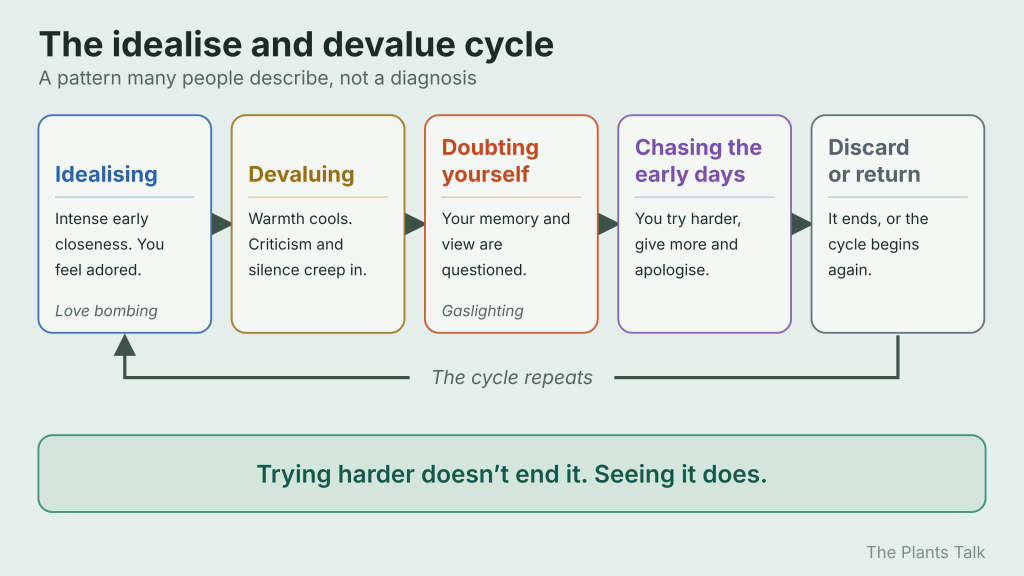
Many people describe a sequence like this, especially with narcissistic or borderline patterns:
- Idealising. The early stage is intense. You’re adored, pursued and told you’re the one. This is often called love bombing.
- Devaluing. Warmth cools. Criticism, contempt, silence and the cold shoulder creep in. You start to feel you’re getting things wrong.
- Doubting yourself. Your memory and perceptions are questioned (“that never happened”, “you’re too sensitive”). This is often called gaslighting. You begin to wonder if something is wrong with you.
- Chasing the early days. You try harder, give more and apologise, hoping the warmth will come back. Sometimes it does, briefly. The unpredictability is part of what keeps you hooked.
- Discard or return. The relationship ends, or goes on in cycles of closeness and withdrawal.
I believe this is why the giver and a self-focused partner can lock together so strongly. One needs to give to feel worthy, and the other needs to be admired or soothed to feel safe. The giver’s worth then depends on someone who isn’t able to give it. See Emotions and the body for how the body reacts to living on edge, and Brain for why an unpredictable pattern of reward and withdrawal can be so hard to walk away from.
Two cautions. First, a label is a poor guide to what to do. What matters is how you are treated, how you feel around them, and whether your perceptions are respected. Second, these words get used loosely, and they can be a way to avoid asking what you brought. Both can be true: someone may have treated you badly, and you may have a pattern that drew you in and kept you there. And if you recognise some of these traits in yourself, that’s useful to know and nothing to be ashamed of. A doctor can point you towards support.
What you bring into the room
Every relationship has more than two people in it. Our parents are there, and so are the roles we learned to play.
- Your parents. How emotionally available they were became your template for what closeness feels like. See Fathers and family.
- Your masks. The self you show a partner may not be the whole you. See Identity.
- Your shadow. The qualities we disown tend to land on those closest to us. The things that irritate us most about a partner are often worth a second look. See The shadow and the unconscious.
- Your body. Your nervous system reacts to closeness and conflict before you do. See Emotions and the body.
- Your brain. Threat, reward and habit shape how hard patterns are to break. See Brain.
- Your roots. Humans are built to belong, and the fear of being cast out runs deep. See Roots.
Intimacy is more than sex
Intimacy means being known by another person. Sex can be part of that, but it isn’t the same thing. Many people can be physically close and emotionally absent, or the other way round.
- Emotional. Sharing what you feel, including the unflattering parts.
- Physical. Touch, affection and closeness that don’t always lead anywhere.
- Intellectual. Sharing ideas and curiosity.
- Shared life. Doing things together, dreaming together, being on the same side.
- Sexual. Wanting and being wanted, in a way that feels safe enough to be real.
When one of these is missing, it often shows up somewhere else. Sex can become the only channel for feelings that have no other outlet. Many men also carry a quiet script about sex: be confident, be ready, never be unsure. Worrying about performing pulls you out of the moment, and out of your body. It can help to talk about it, with your partner or with a therapist if that suits you. Sex and desire have physical causes as well as emotional ones, so if you have persistent difficulties, talk to your doctor first.
Friendship and loneliness
Relationships aren’t only romantic. Many men, especially after their twenties, find their circle shrinking. Friends become people you do things with, not people you tell things to. Close friendship follows the same rules as any closeness: it asks you to be a little more honest than is comfortable. One real friend who knows what’s going on for you is worth more than a dozen who don’t.
Moving towards closer connection

- Notice your pattern. Do you chase, withdraw, give to earn, or swing between them? Writing it down helps.
- Look back. Whose approval were you trying to win? Whose mood did you learn to manage?
- Catch the trigger. Ask what happened just before you reacted. Often it’s something small.
- Pause before you act. A few slow breaths can open a gap between the feeling and the reaction.
- Say what’s underneath. “I’m scared” or “I need a minute” does more than the anger or silence it replaces.
- Practise saying no. Start with something small. Notice that the relationship survives.
- Give freely, or not at all. Ask whether you’re giving from care or to be kept.
- Repair. Every relationship has ruptures. What matters is coming back, saying sorry and trying again. If the other person can’t or won’t, that tells you something too.
- Take it in small steps. Trust is rebuilt in small, repeated moments, not grand gestures.
- Get support if you need it. A therapist or a trusted friend can help you see what you can’t see alone.
Old patterns don’t vanish quickly, and slipping back doesn’t mean failing. Each time you notice and choose differently, the pattern loosens a little.
Frequently asked questions
Why do I pull away when someone gets close?
Usually because closeness once felt unsafe, or came at a cost. Withdrawing was a way to protect yourself. It’s a learned reflex, not a character flaw, and it can change.
Why do I need so much reassurance?
Often because, early on, comfort wasn’t reliable. The need isn’t weakness. It’s a sign something once went unmet. Learning to soothe yourself, and to ask clearly, can help.
Why do I keep ending up with the same kind of partner?
We tend to be drawn to what feels familiar, and familiar isn’t always good for us. Understanding what you grew up with, and what it taught you to expect, is often what breaks the loop.
I give and give. Why isn’t it enough?
Because if you’re giving to earn love, no amount will feel like enough. The need is to feel worthy as you are, not to give more. See the giver section above.
Does my partner have a personality disorder?
Only a qualified clinician can, and only after assessing the person themselves. What you can look at is the pattern: how you are treated, how you feel around them, and whether your perceptions are respected. If you’re regularly made to doubt yourself or feel afraid, that matters whatever label it has.
Can someone with these patterns change?
I believe it’s possible for some people, usually with specialist support and a real wish to change. It tends to be slow, and it can’t be done for them. You can’t fix someone else, and you don’t have to stay in order to prove you tried.
Is this abuse?
If you feel afraid, controlled, cut off from friends or family, or regularly put down, that is serious, whatever it’s called. Please talk to someone you trust, your doctor, or a local domestic abuse service. If you’re in danger, contact your local emergency services.
Can attachment patterns change?
I believe they can. Many people become more secure over time through steady, honest relationships and, for some, through support from a therapist. It takes patience and practice.
Is it me or the relationship?
Often both. Some patterns are yours and some belong to the dynamic between you. Looking at your own part is something you can do whatever the other person does.
Why can’t I talk about feelings with my partner?
Usually because you never learned how, or because feelings were unwelcome growing up. It’s a skill, and it can be learned a small step at a time. See Emotions and the body.
Does my relationship with my parents affect my relationships now?
Often, yes. It’s where many of us learned what closeness looks like. See Fathers and family.
How do I make friends as an adult?
Start small and be consistent. Regular, low-pressure contact builds trust. Then be a little more open than feels comfortable.
Should I stay or leave?
Only you can decide, and I can’t answer that for you. It may help to understand your own patterns first, so you’re choosing from clarity and not from fear. If you’re unsafe in any way, please seek help straight away.
Connected to
Fathers and family · Identity · Trauma · The shadow and the unconscious · Emotions and the body · Brain · Roots
Read more
New writing on relationships lands here first. Join the list, or if you’d rather talk, book a free intro call.
If anything here brings up difficult feelings, you don’t have to carry them alone. If you’re in crisis or thinking of harming yourself, please contact your local emergency services or a crisis line. You can find one for your country at findahelpline.com.
